
Obtain An EUID Code For The European Register.
Securing an EUID code is a critical step for any UK business seeking to register a presence on the European register. This unique identifier, established under Directive 2012/17/EU, connects foreign company records across EU member state systems and is non-negotiable for formal branch entry. Without it, your commercial branch cannot be formally recognised within European interconnected registers.
Many UK companies are caught off guard by the volume and precision of notarised documentation required before a european register authority will process a commercial branch application — so do you know exactly which certified documents your branch registration package must contain?
Key Takeaways
- An EUID code links UK companies to EU registers under Directive 2012/17/EU
- Notarised UK incorporation documents are mandatory for branch entry
- A Notary Public certifies authority, identity, and document authenticity
- Apostille or embassy legalisation is often required alongside notarisation
- Corporate authority documents must accompany all branch registration packs
Get Your EUID Code Documentation Right From The Start
Why the EUID Code Exists in European Company Law
The EUID code is a standardised alphanumeric identifier assigned to companies and their branches within European Union member states. Introduced by Directive 2012/17/EU on the interconnection of business registers, it allows foreign company records to be cross-referenced across national registers throughout the EU. Each code is unique and permanent once assigned.
The system was designed to eliminate duplication and inconsistency across divergent national corporate registers. For a UK company opening a commercial branch in Italy, France, or Spain, the EUID code ties the branch record back to the parent entity at Companies House. This means that the European register authority for your destination country can independently verify the existence and standing of your UK business without relying solely on documents you submit yourself. That independent cross-verification is precisely why the documentation package you present at the outset must be airtight.
How a Notary Public Supports the Application Process
A Notary Public authenticates the UK corporate documents required for a European register submission. This includes certifying the Certificate of Incorporation, Articles of Association, and evidence of director authority. The notary’s seal and signature give foreign registration authorities independent assurance that the documents are genuine and that the signatories have the legal capacity to act.
Unlike a solicitor, whose primary duty runs to their client, a Notary Public owes their duty to the transaction and the global legal order. This distinction matters enormously to civil law jurisdictions across Europe, which place significant weight on notarial certification as a mark of independent public verification. Notary Services Limited, regulated by the Faculty Office of the Archbishop of Canterbury, provides precisely this level of certified authentication for UK companies pursuing European commercial branch registration.
| Document Type | Purpose for EUID / Branch Registration |
|---|---|
| Certificate of Incorporation | Proves the UK parent entity legally exists |
| Certificate of Good Standing | Confirms active compliance status with Companies House |
| Articles of Association | Evidences constitutional authority for branch activities |
| Board Resolution | Authorises the opening of the European commercial branch |
| Director ID Documents | Verifies identity of signatories for the registration |
| Power of Attorney | Appoints local legal representative in the destination country |
| Deed of Appointment | Names the local legal representative formally |
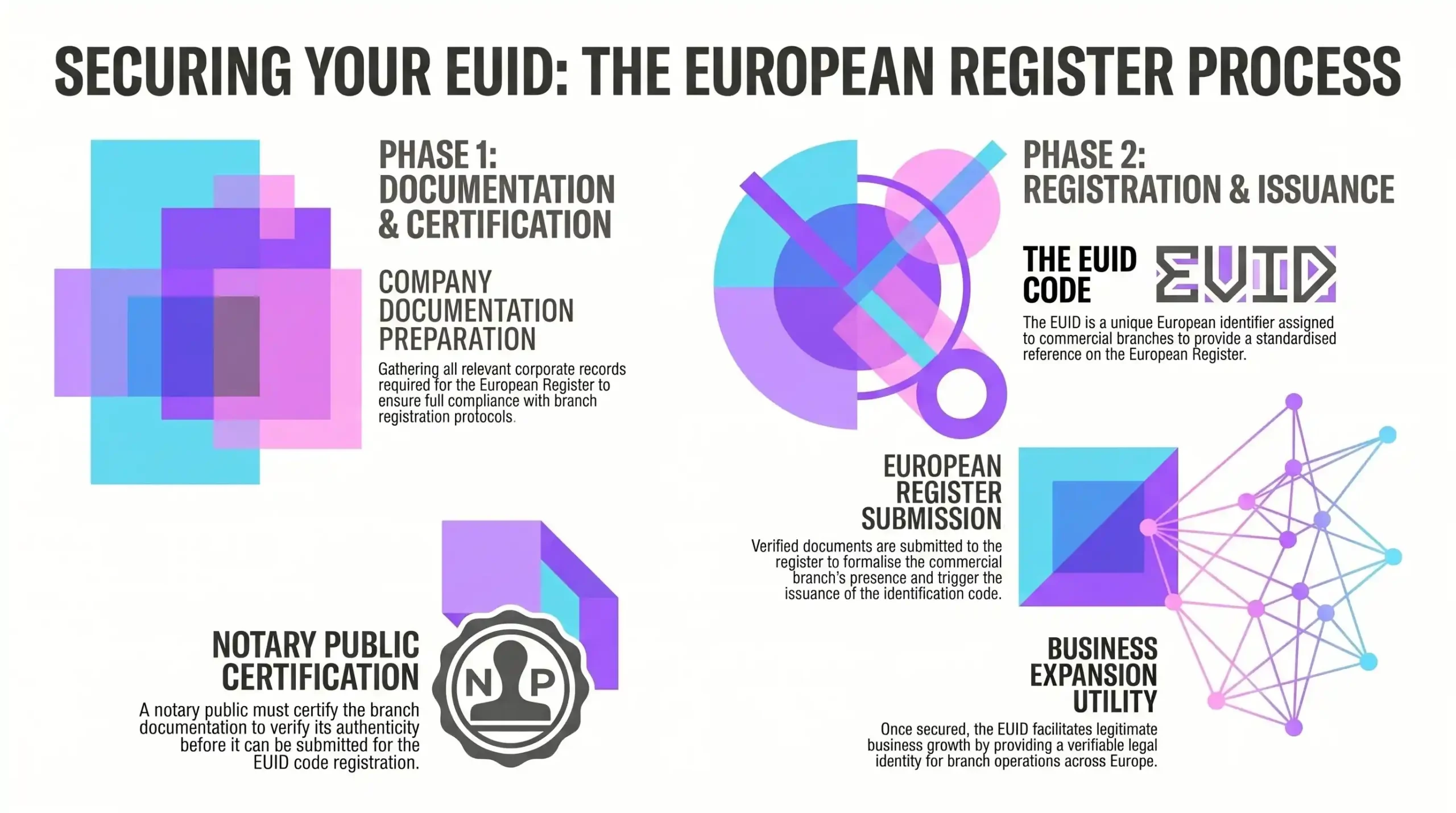
Steps to Prepare Your Core Corporate Documents
Verify the Certificate of Incorporation First
The Certificate of Incorporation is the foundational document in any European register application. Issued by the Registrar of Companies, it confirms when and where the UK business was incorporated. For a commercial branch registration, the destination country’s register authority will require a notarised copy, and in many EU jurisdictions, an apostille from the FCDO is also required.
The apostille is issued by the Foreign, Commonwealth and Development Office and authenticates the notary’s own signature and seal for international use. Some EU countries accept apostilled documents directly. Others, particularly those outside the Hague Convention network or with additional bilateral requirements, may require further embassy or consulate legalisation. Establishing which level of authentication your target jurisdiction demands before you begin saves considerable time and cost. Notary Services Limited can advise on the precise chain of legalisation needed once you confirm the destination country.
Apply the Certificate of Good Standing to Confirm Active Status
A Certificate of Good Standing is issued by the Registrar of Companies to confirm that a UK company is properly registered, has filed its required documents, and remains in active status. European register authorities routinely request this document when processing commercial branch applications, as it confirms the parent entity is not dissolved, struck off, or subject to administrative action.
Bear in mind that this certificate has a limited shelf life. Many European authorities will only accept a Certificate of Good Standing issued within the previous three months. This means the timing of your notarisation appointment should be coordinated with the issue date of the certificate to avoid the need for a repeat application. Your notary can review the certificate at the point of authentication and flag any currency issues before the document pack is submitted to the european register.
Notary Services for Businesses
Businesses who engage in overseas activities often require documents to be notarised. Notary Services Limited notarise a wide range of business documents including certification of accounts, board resolutions, companies house documentation and many others.
How to Execute Authority Documents for Branch Registration
Draft a Board Resolution Authorising the Branch
A board resolution formally records the decision of a company’s directors to establish a commercial branch in a European jurisdiction. For the purposes of a european register submission, the resolution must clearly authorise the branch, identify the legal representative who will act locally, and confirm the signatory’s authority. It should be prepared on company letterhead and reference the intended jurisdiction explicitly.
Board resolutions do not need to be witnessed directly by a Notary Public in order to be valid as an internal corporate document. That said, foreign registration authorities frequently require the notary to certify that the resolution is a true and accurate copy of the original and that it was passed by a duly authorised board. This notarial certificate is what gives the document its evidential standing in the european register process. Preparing the resolution before your appointment and sharing a draft with your notary in advance allows any deficiencies to be corrected without delay.
Execute a Power of Attorney for the Local Representative
Most European commercial branch registrations require a Power of Attorney appointing a local legal representative who can interact with the destination country’s register on behalf of the UK parent company. The Power of Attorney must be signed in the presence of a Notary Public, who will verify the identity of the grantor and confirm they understand the document’s effect and scope.
For registrations in countries such as Italy or Spain, the Power of Attorney will typically need to be apostilled by the FCDO following notarisation. In some cases, it must also be translated into the local language by a certified translator, with the translation itself bearing a notarial certification. At Notary Services Limited we regularly handles cross-border Powers of Attorney for European jurisdictions, managing both the notarisation and the subsequent apostille procurement to keep the process efficient for businesses working to tight registration timelines.
Notary Services for Professionals
Notary Services Limited notarise documents for the clients of many professions, such as solicitors, accountants, architects, doctors, insolvency practitioners, patent agents and trademark agents.
Why Identity Verification Underpins Every EUID Application
Confirm the Identity of Every Authorised Signatory
Every person who signs documents in connection with a european register application must have their identity independently verified by the Notary Public. Acceptable photographic identification includes a current passport or photo driving licence. Proof of address, such as a utility bill or bank statement no older than three months, is also required. This applies to directors, authorised signatories, and any individual granting a Power of Attorney.
Where the signatory is acting on behalf of a company rather than as an individual, the notary must also verify that the person holds the authority to bind that company. This is established through constitutional documents such as the Articles of Association, a company extract listing directors, an authorised signatory list, a board resolution, or a Power of Attorney. If any link in this chain of authority is missing or unclear, the notary cannot proceed. Submitting incomplete identity documentation is one of the most common reasons commercial branch registration packs are returned by european register authorities.
Apply Extra Checks for Foreign Parent Companies
Where the applicant is not a UK-registered company but a foreign parent seeking to register a commercial branch through a UK intermediary, additional identity verification applies. Foreign companies must provide a Certificate of Incorporation, a Certificate of Good Standing or incumbency certificate, or a company extract from their local commercial register. These documents must be translated and, where required, legalised for use in the UK.
The Economic Crime and Corporate Transparency Act 2023 has sharpened the verification requirements that Companies House and associated registration processes demand of directors and Persons with Significant Control. Notaries, who are deeply accustomed to forensic-level identity checks, are well positioned to assist foreign-parent structures in satisfying these obligations before submitting documentation to a european register. Overlooking these enhanced requirements is a costly error that can stall a commercial branch application entirely.
Notary Public in Manchester
Manchester Notary Services Ltd
Notary Public in Manchester
Manchester Notary Services Ltd
Notary Public in Manchester
Manchester Notary Services Ltd
Company & Business Documentation
We notarise a comprehensive range of business and corporate documentation. Alongside our core notarial services, we also verify that the requisite corporate authorities are in place and manage the procurement of apostilles, as well as consular or embassy legalisation.
Get the Apostille and Legalisation Chain Right
Secure an Apostille Through the FCDO
An apostille is an official certificate issued by the Foreign, Commonwealth and Development Office that authenticates a notary’s signature for recognition in countries party to the 1961 Hague Convention. For commercial branch registration across most EU member states, an apostille on each notarised document is a standard requirement. The apostille does not verify the content of the document — it verifies the notary’s authority.
Notary Services Limited manages apostille procurement on behalf of clients, submitting notarised documents to the FCDO and arranging for their return. This service reduces the administrative burden on businesses and ensures the apostille is correctly applied to each document in the pack. Turnaround times vary depending on the FCDO’s current processing schedule, so building sufficient lead time into your european register application timeline is strongly advisable. Rush processing is available at additional cost if your commercial branch registration deadline is pressing.
Arrange Embassy Legalisation Where Required
Certain European jurisdictions require a further layer of authentication beyond the apostille, involving legalisation by the relevant country’s embassy or consulate in the UK. This is known as consular legalisation and confirms that the FCDO apostille itself is valid. It is more commonly required for jurisdictions outside the Hague Convention but occasionally arises within EU member state processes depending on bilateral arrangements.
The process involves physically lodging the apostilled documents with the relevant embassy, paying the required consular fee, and waiting for the embassy to apply its own certification stamp. Notary Services Limited can manage this on your behalf, drawing on established experience of the documentation and fee structures across multiple embassies. Attempting to navigate this process without professional support often results in documents being rejected for minor formatting or sequencing errors, causing delays that could set back your EUID code application and commercial branch launch date.
Patent Agents
We provide expert notary services for patent agents to authenticate IP assignments, powers of attorney, and priority documents for foreign patent offices.
Apply Translated Documents Correctly to the European Register
Obtain Certified Translations of All UK Documents
Every document submitted to a European register authority must be in the official language of the destination country. This means that all notarised UK corporate documents, including the Certificate of Incorporation, Articles of Association, board resolutions, and Powers of Attorney, must be professionally translated. The translator must provide a certificate confirming the translation is accurate and complete, along with their name, address, and relevant qualification.
Where Notary Services Limited arranges translations, the translated document is linked directly to the notarised original. This creates a single, verifiable document bundle that meets the evidentiary standards of European register authorities. Poorly executed translations, or translations that are not certified, are a frequent cause of rejection. Bear in mind that some jurisdictions require the translation itself to be separately notarised or apostilled, adding an additional step to the chain that must be planned for well in advance of your target commercial branch registration date.
Understand Dual-Language Document Requirements
Some European jurisdictions, particularly those with civil law traditions such as Spain and Italy, require key registration documents to be presented in dual-language format — meaning the original English text appears alongside a certified translation in the local language. This is common for Powers of Attorney and deeds of appointment for local legal representatives. The dual-language structure ensures the receiving authority can verify consistency between versions.
Notary Services Limited has substantial experience producing and authenticating dual-language documents for European commercial branch registrations. The notary reviews both the English and translated text to confirm that the legal meaning is preserved across both versions before certifying. This is particularly important for Powers of Attorney, where subtle translational differences in the scope of authority granted can cause significant legal complications for the local representative acting on behalf of the UK parent company.
Did You Know?
The EUID code system was established by Directive 2012/17/EU on the interconnection of central, commercial, and companies registers across EU member states. Registering a commercial branch in Italy, for example, requires submission of a certified UK deed of incorporation, payment of Chamber of Commerce fees, and a formal deed of appointment for the local legal representative — all of which must be authenticated by a Notary Public before the european register will process the application and assign a unique identifier.
Why Identity Verification Underpins Every EUID Application
Confirm the Identity of Every Authorised Signatory
Every person who signs documents in connection with a european register application must have their identity independently verified by the Notary Public. Acceptable photographic identification includes a current passport or photo driving licence. Proof of address, such as a utility bill or bank statement no older than three months, is also required. This applies to directors, authorised signatories, and any individual granting a Power of Attorney.
Where the signatory is acting on behalf of a company rather than as an individual, the notary must also verify that the person holds the authority to bind that company. This is established through constitutional documents such as the Articles of Association, a company extract listing directors, an authorised signatory list, a board resolution, or a Power of Attorney. If any link in this chain of authority is missing or unclear, the notary cannot proceed. Submitting incomplete identity documentation is one of the most common reasons commercial branch registration packs are returned by european register authorities.
Apply Extra Checks for Foreign Parent Companies
Where the applicant is not a UK-registered company but a foreign parent seeking to register a commercial branch through a UK intermediary, additional identity verification applies. Foreign companies must provide a Certificate of Incorporation, a Certificate of Good Standing or incumbency certificate, or a company extract from their local commercial register. These documents must be translated and, where required, legalised for use in the UK.
The Economic Crime and Corporate Transparency Act 2023 has sharpened the verification requirements that Companies House and associated registration processes demand of directors and Persons with Significant Control. Notaries, who are deeply accustomed to forensic-level identity checks, are well positioned to assist foreign-parent structures in satisfying these obligations before submitting documentation to a european register. Overlooking these enhanced requirements is a costly error that can stall a commercial branch application entirely.
Make an Enquiry
Summarise EUID Code Essentials
Obtaining an EUID code for the european register is a structured, document-intensive process that demands precision at every stage. From the initial notarisation of your Certificate of Incorporation and Articles of Association, through the apostille chain at the FCDO, to the certified translation and submission of a complete registration pack, each step must be executed correctly. A Notary Public sits at the centre of this process, providing the independent authentication that civil law jurisdictions across Europe require before they will accept and process a commercial branch application.
Notary Services Limited, based in Manchester and regulated by the Faculty Office of the Archbishop of Canterbury, supports UK businesses through every stage of this documentation process. Whether your commercial branch registration target is Italy, Spain, France, or another EU member state, the starting point is the same — get your UK corporate documents professionally notarised, apostilled, and translated before you submit anything to a european register authority. Contact Notary Services Limited to request a quote and begin the process.
Notary Services Limited
Regulated by the Faculty Office of the Archbishop of Canterbury and Member of the Notaries Society


Frequently Asked Questions
Q: What is an EUID code and why does a UK company need one?
A:
An EUID code is a unique European identifier assigned to companies and their branches under Directive 2012/17/EU. It links a commercial branch registered in an EU member state back to the parent entity on its home country’s register, such as Companies House in the UK. Any UK company opening a physical commercial branch within the EU must obtain one as part of the formal european register application process. Without it, the branch cannot be legally recognised within EU interconnected register systems.
Q: Which documents need to be notarised for a European register commercial branch application?
A:
The core documents requiring notarisation typically include the Certificate of Incorporation, Certificate of Good Standing, Articles of Association, a board resolution authorising the branch, and a Power of Attorney for the local legal representative. Director identity documents must also be verified by the notary. Each notarised document then requires an apostille from the FCDO and, in some cases, further embassy legalisation, before the european register authority will accept the submission.
Q: Does the EUID code application require an apostille on every document?
A:
In most EU member states, yes. An apostille issued by the Foreign, Commonwealth and Development Office authenticates the notary’s signature and seal, making the document internationally recognised under the 1961 Hague Convention. Some countries may also require consular legalisation on top of the apostille. The precise requirements depend on the destination country, so it is essential to confirm the full authentication chain needed before notarisation begins to avoid having to repeat the process.
Q: How long does the notarisation and apostille process take for a commercial branch registration?
A:
Timescales vary. Notarisation itself can typically be arranged within a few days of an appointment at Notary Services Limited. FCDO apostille processing times fluctuate based on current demand, with standard processing taking several working days and premium services available for urgent requirements. Where embassy legalisation is also needed, additional time must be factored in. Certified translations add further time. Building at least three to four weeks into your overall timeline before the european register submission is a practical minimum.
Q: Can Notary Services Limited manage the entire documentation process for an EUID application?
A:
Yes. Notary Services Limited handles the full range of corporate document notarisation required for european register submissions, including Certificates of Incorporation, Articles of Association, board resolutions, and Powers of Attorney. The practice also manages apostille procurement through the FCDO and can arrange consular legalisation where required. Certified translations can also be coordinated. To begin, contact Notary Services Limited by phone on 0161 818 7956 or by email at info@notaryservicesltd.co.uk to discuss your commercial branch registration requirements and receive a quote.
Share This Article